


N° 01 — Where does it hurt?
Choose the problem closest to yours to see how we treat it, how many sessions it usually takes and who on the team specialises in it.


N° 02 — How it works
01
Assess
A full hour to hear the story and test how you move. You leave knowing what is wrong and what will help.
02
Treat
Hands-on treatment to settle pain early, and a small number of exercises chosen for your body and your week.
03
Strengthen
We build the strength and confidence that keep it away, one-to-one or in a small clinical Pilates class.
In numbers
Figures from our own patient records and reviews, updated every season.
Treatments
What we do
Treatments for every stage of recovery
Every treatment,
one clear plan,
from people who
know your body.
Physiotherapy assessment
Follow-up physiotherapy
Osteopathy
Chiropractic care
Sports massage
Sports rehab session
Clinical Pilates 1:1

01
What happens
A full hour: 20 minutes to hear the story, a thorough physical assessment, and a clear explanation of what we found. Treatment starts in the same session. You leave with a written plan, two or three exercises and a realistic timeline.
Your first appointment. We listen, test, explain what is going on and start treatment the same day.

02
What happens
Each follow-up starts with what has changed since last time. We treat, progress your exercises and adjust the plan. Most people need fewer sessions than they expect.
Hands-on treatment, progressions to your exercises and a check that the plan is working.

03
What happens
Osteopathy looks at how the whole body moves around a painful area. Treatment uses soft-tissue work, joint articulation and gentle manipulation where appropriate, alongside advice and exercise.
Whole-body manual therapy for back, neck and joint pain, with gentle joint and soft-tissue techniques.

04
What happens
Chiropractic care at Mend is evidence-led. Adjustments are one tool among several, used when they help, and always combined with exercise so the change lasts.
Assessment and spinal adjustment for back and neck pain, always paired with movement advice.

05
What happens
Firm, focused work on the areas that need it, with stretching and advice for the days after. Good on its own or as part of a rehab plan.
Deep soft-tissue work for tight, overworked muscles, before an event or during a heavy block of training.

06
What happens
A coached session in our rehab studio. We test where you are, train what is missing and measure progress each time, until you pass your return-to-sport tests.
One-to-one gym-based rehab to rebuild strength, power and confidence after injury.

07
What happens
The same careful assessment as a physio appointment, then a reformer session built for your body. Ideal before joining a group class, or when you need close supervision.
A private reformer session led by a physiotherapist, built around your injury or goal.

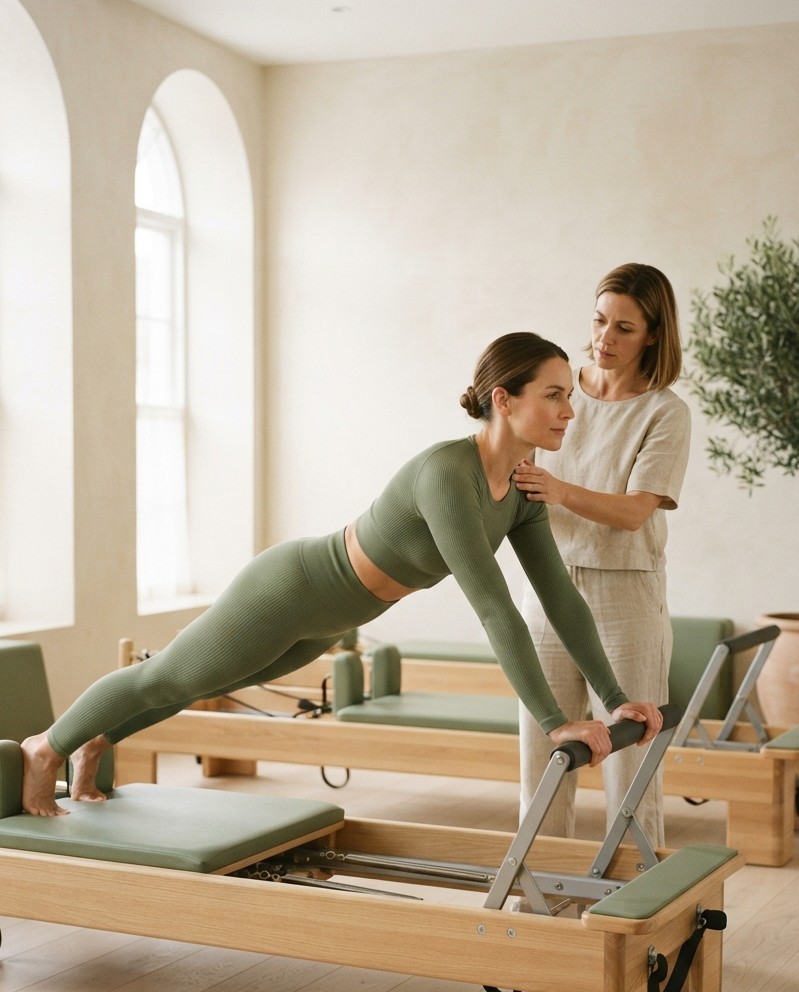
N° 04 — Clinical Pilates
Small reformer classes, five people at most, each built around a clinical goal. Most people join after a 1:1, so we know your body before you arrive.
This week
Mon
07:15
Pilates Foundations
Mon
18:30
Back Care
Tue
12:30
Reformer Flow
Tue
19:00
Run Strong


N° 06 — In their words
After two years of on-and-off back pain, six sessions with Nadia and I finally understand it. I haven’t had a flare-up since the spring.
Hannah M.
Lower back pain
Sam got me from ACL surgery to my first match in nine months. Every stage had a test, so I always knew where I stood.
Joe R.
ACL reconstruction
The Pilates classes are small enough that Mei notices everything. My hypermobile knees have never felt so solid.
Priya S.
Clinical Pilates
N° 07 — Journal

4 min read
Should you rest a sore back?
Mostly, no. Here is what to do in the first few days instead, and when to call someone.

6 min read
Training for your first half marathon without getting hurt
Most running injuries are training errors. Three rules that keep beginners on the road.

3 min read
What makes Pilates ‘clinical’?
Same reformer, different starting point. Why our classes begin with an assessment.